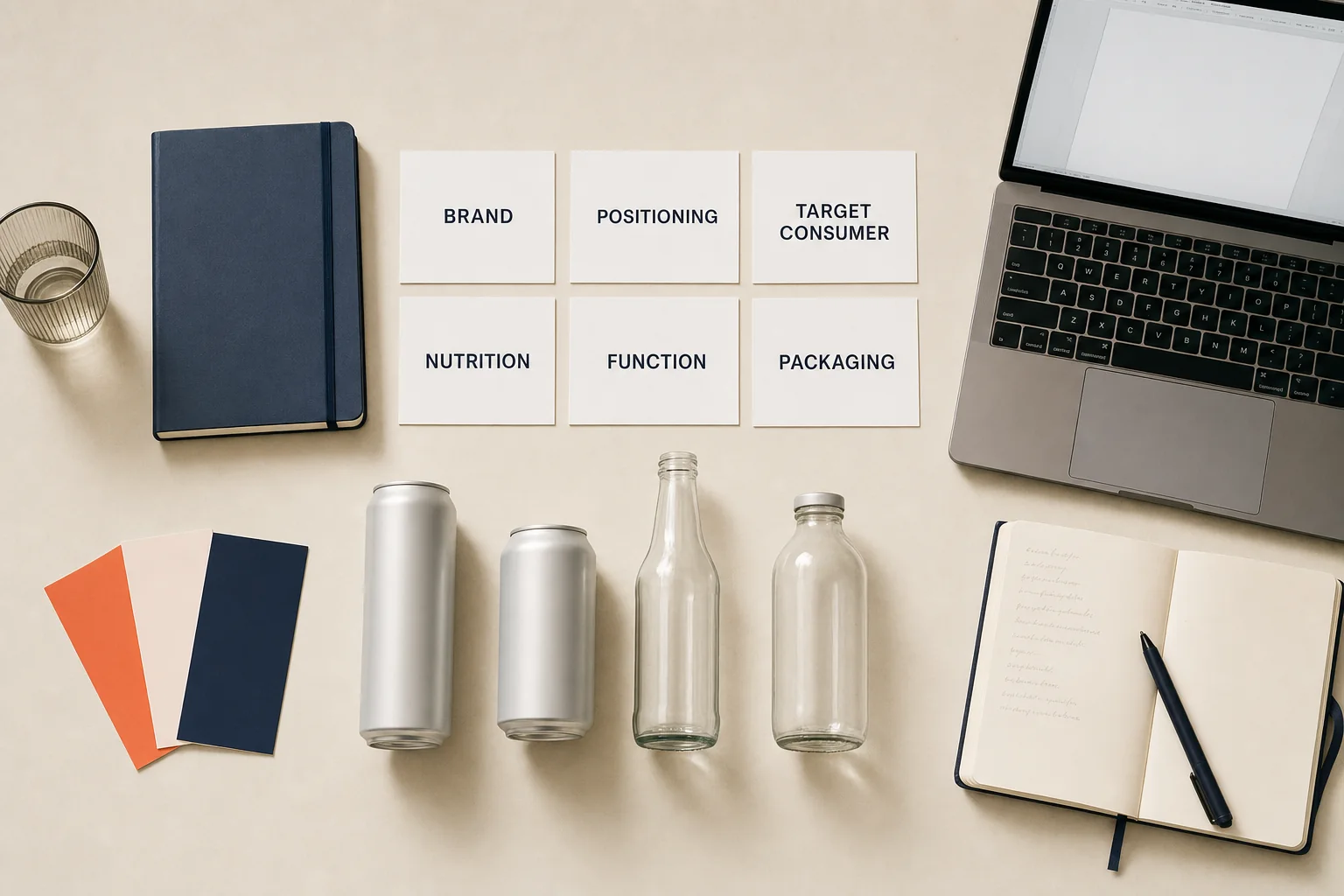
The beverage launch map
Before the detail, here is the whole path on one page. Every beverage brand, from a functional soda to a protein shake to a botanical tonic, moves through these eight stages in roughly this order. The order is the point: each stage produces the input the next one needs.
| # | Stage | What you actually do | What you walk away with |
|---|---|---|---|
| 1 | Validate | Test that someone will buy this before you spend real money. | Evidence of demand |
| 2 | Product brief (PRD) | Write down what you're making, plus the price and cost targets it must hit. | A documented spec |
| 3 | Bench sample | Develop the recipe with a formulator until it tastes right and can scale. | A formula you can produce |
| 4 | Processing path | Decide how the product is made safe and shelf-stable. | The right process |
| 5 | Financial model | Cost it out per unit with real quotes and confirm the economics work. | Unit economics that add up |
| 6 | Co-packer | Find and qualify the facility that will make it. | A signed manufacturing partner |
| 7 | First production | Stage the supply chain, run a pilot, produce. | Finished goods |
| 8 | Launch & grow | Choose distribution, land accounts, sample, sell, and plan the reorder. | A brand in market |
A note from Matt
It took me three years of trial, error, and expensive lessons to turn my beverage brand into a commercialized product. It shouldn't have. The early stages, R&D, operations, and getting to something commercially viable, are where founders lose the most time and money, simply by not moving fast enough. Handing those stages to technical experts gives you the launch pad I never had. That's what we do at JAI.
Step 1: Validate before you spend
The cheapest stage is the one most founders skip. Before you pay a formulator or design a label, get real evidence that people want this product at a price that works. Validation does not mean asking friends if they like the idea. It means putting something in front of strangers and watching what they do.
Concrete ways to validate cheaply: see if you can make small batches in a commercial kitchen and sell them at a local market, gym, or cafe; run a simple pre-order page and see if anyone actually pays; sample at events and count how many people come back for a second. The goal is signal, not scale. You're answering one question: does demand exist beyond your own enthusiasm?
How to decide whether you've validated
- Keep going when strangers pay full price, come back, and tell other people, even at tiny scale.
- Iterate when people are polite but don't repurchase. Something about the product, price, or positioning isn't landing yet.
- Pause when the only demand is from people who know you. That's encouragement, not a market.
Step 2: Write the product brief
Once you believe in the concept, write it down. A product brief, sometimes called a Product Requirements Document or PRD, is the single document that says exactly what you're making before anyone starts mixing. It is the spec a formulator works to and the reference everything downstream points back at.
A useful beverage brief names: the category and format (a 12oz canned sparkling tonic, a 16oz protein shake), the flavor and sensory target, the functional claims and ingredients you want, dietary and label requirements (vegan, no added sugar, organic), your target price and rough COGS ceiling, and the packaging direction. The more decisions you make here, the fewer expensive surprises later.
What a good product brief covers
- Category, format, and serving size
- Flavor and sensory target (sweetness, acidity, mouthfeel, color)
- Functional ingredients and the claims you want to make
- Dietary and certification requirements (vegan, organic, gluten-free)
- Target retail price and the COGS ceiling that price implies
- Shelf-life target and intended distribution (refrigerated vs. shelf-stable)
Set your target economics before you formulate
This is the part most founders skip, and it belongs right here in the brief. Before a formulator mixes anything, decide two numbers: the retail price you believe the market will pay, and the target COGS ceiling that price leaves room for once the retailer and distributor take their margins. Those numbers are an input to formulation, not an afterthought. A formulator can build to a cost target, swapping or dosing ingredients to land near it, but only if you give them one. Skip this and you risk falling in love with a formula you can't afford to make. You'll build the full, quote-backed financial model in Step 5; right now you just need the guardrails.
If you've never written one, start from ours. The free Beverage PRD template below is the exact structure JAI uses to capture a product before formulation, with one already filled in for a sample drink (including target price and target COGS fields). This is also the handoff a formulator owns: JAI's beverage formulation service turns a founder's concept into a documented brief and then a scalable formula.
Step 3: Build your first bench sample
This is where the idea becomes something you can taste. A formulator develops benchtop samples against your brief, you taste and give feedback, and you iterate over several rounds until the formula is locked. A kitchen recipe is a starting point, not a finished formula: a professional formulator translates your concept into something that uses commercially available ingredients, stays stable on a shelf, hits your cost target, and can actually run on a production line.
Expect more than one round. The first sample is rarely the last. Good formulation is a loop of taste, feedback, and refinement, and the founders who get the best result are the ones who give specific, honest feedback at each round rather than a vague "make it better."
Common founder mistake
Locking your packaging and label artwork before the formula is final. Ingredients change during formulation, and an ingredient change can change your nutrition panel, your claims, and even your net contents. Founders who print labels early often pay to reprint them. Lock the formula first, then finalize the label against the real, final spec.
Step 4: Choose your processing path
How your beverage is made safe and shelf-stable is not a small technical footnote. It shapes your formula, your shelf life, your minimum order quantity, your cost, and which co-packers can even make your product. Decide it deliberately, with your formulator, rather than discovering it late.
The common paths, simplified:
- Hot-fill: the product is heated, filled hot, and the heat sterilizes the package. Common, widely available, good for many juices and teas.
- Cold-fill with preservatives: filled cold, kept safe with formulation and preservatives. Simple and inexpensive where it fits, but may not be preferred for the health and wellness focused consumer.
- Tunnel pasteurization: filled, sealed, then pasteurized in the package. Common for many carbonated and fermented products.
- HPP (high-pressure processing): a non-thermal "cold" method that preserves fresh-pressed character; usually refrigerated distribution.
- Aseptic: product and package are sterilized separately, then filled in a sterile environment. Protects heat-sensitive ingredients and gives long ambient shelf life, but carries higher cost and bigger minimums.
- Powder / ready-to-mix: not a liquid fill at all; a different manufacturing path entirely (sachets, sticks, tubs).
How to choose a processing path
- Start with shelf life and distribution. Refrigerated or shelf-stable? That single answer rules out half the options.
- Then ingredient sensitivity. Heat-sensitive actives or live cultures push you toward gentler methods like HPP or aseptic.
- Then cost and MOQ. Aseptic protects fragile formulas but raises both cost and minimums. Don't default to it because it sounds premium.
If you've been told "you need aseptic," weigh it carefully before committing; it's a business-model decision, not just a filling method. Our dedicated aseptic filling guide (publishing soon) walks the full trade-off, and JAI's production operations support helps you match the right process to the right co-packer.
Step 5: Build the financial model
You set target economics back in the brief. This is where you replace the targets with real numbers and find out whether the business actually works. There are really two passes at the financial model: the target (a back-of-envelope ceiling you set before formulating) and the real model you build here, once you have a locked formula, supplier quotes, and a co-packer estimate. The detailed model has to come after formulation because that's when you finally know what the product truly costs.
Start with COGS (cost of goods sold): what one unit costs to make. For a beverage that's ingredients, packaging (can or bottle, closure, label, secondary packaging), the co-packer's run charge, and inbound and outbound freight. Add it up per unit at your real run size. Then build the rest of the model around it: the margin stack, break-even, and working capital.
The margin stack: why COGS has to be low
Your retail price is not your revenue. Every party between you and the drinker takes a cut, and those cuts compound. This is why beverage COGS usually has to land around a quarter to a third of the shelf price for the math to work. The exact splits vary by category and channel, but the shape is consistent:
| Channel | Who takes a margin | What you typically net (of shelf price) |
|---|---|---|
| Direct-to-consumer | You keep the full price, but pay customer acquisition, payment fees, and fulfillment | Highest gross margins, but acquisition costs eat into it |
| Retail (you sell direct to the store) | Retailer keeps roughly 30% to 40% | ~60% to 70% |
| Distributor to retail | Distributor ~20% to 30% (higher for DSD or regional), then the retailer ~30% to 40% | ~45% to 50% |
Work an example through it. If your can sells for $2.99 on a shelf you reached through a distributor, you might net around $1.40 of that. Out of $1.40 you have to cover COGS and your expenses and still make a margin. If the product costs $1.20 a unit to make, you're underwater the moment it goes through distribution, even though $2.99 "felt" like plenty. That is exactly the gap the model exists to catch.
One more wrinkle: these net figures are before trade spend (retailer promotions, slotting, and discounts), so your true realized margin runs a little lower. Build a trade-spend line into the model from the start so it doesn't surprise you later.
Common founder mistake
Setting a retail price by looking at the shelf, then working backward and hoping the costs fit. Do it the other way: build COGS from real ingredient and packaging quotes, subtract the margins each channel takes, and see what's left to cover your cost. If nothing's left, change the product, the format, or the channel, not the spreadsheet.
Break-even and working capital
Two more numbers decide whether you survive the launch, and both surprise first-time founders:
- Break-even. Per-unit margin is not profit until it has paid back your fixed launch costs (formulation, branding, setup fees, that first run). Divide your fixed costs by your margin per unit to see how many units you have to sell just to get back to zero. For many first runs, that break-even number is uncomfortably close to the size of the entire production run, meaning you have to sell almost the whole batch just to recover your launch costs.
- Working capital. You pay the co-packer for the full run up front. Retailers and distributors then pay you on terms, often 60 days after they receive product, and sometimes longer. That gap, between cash out for production and cash back from sales, sinks more early brands than weak demand does. Model it, and make sure you can fund it.
How to read your model
- Green light when your real COGS lands inside the target, the margin survives your intended channel, and you can fund the working-capital gap to your first reorder.
- Rework the product when COGS comes in over target: cut or re-source an ingredient, change the format or pack size, or move to a channel with a shorter margin stack.
- Stop and rethink when no realistic price clears COGS plus channel margins. That's the business model telling you something before the market does.
Step 6: Find and qualify a co-packer
A co-packer (also called a co-manufacturer or contract manufacturer) is the facility that physically produces your beverage. Most early beverage brands use one because building and operating a compliant production facility requires substantially more capital, time, and operational expertise. Choosing the right one is the highest-stakes operational decision before launch.
This is its own deep topic, and we've written the full framework. The short version: evaluate every candidate on the same six criteria (capability, capacity, certifications, equipment, geography, and performance), don't choose on price alone, and always visit the facility. The MOQ (minimum order quantity) varies by product, package, process, line, and manufacturer, and it will be one of the biggest drivers of your first-run cost.
For the complete method, including the questions to ask, the documents to request, the red flags that should make you walk away, and a free weighted scorecard, read our guide on how to choose a co-packer for your first production run.
A note from Matt
At launch volume, you're evaluating the co-packer, but the co-packer is also deciding whether your run fits their line, schedule, and economics. A "no" usually isn't a verdict on your brand. It means your volume, format, or timeline doesn't match that facility. Smaller co-packers take smaller runs, and that's who most first-time founders should target.
Step 7: Prepare for first production
Signing the co-packer is the start of production, not the end of the work. Between a signed agreement and finished goods, several things have to come together. Get them ready and your first run goes smoothly. Skip one and the line waits on you, which can be costly.
What you need ready before your first run
- A signed MSA (Master Services Agreement) that keeps your formula and IP as your property
- A finished production specification the co-packer produces against
- Ingredients and packaging staged on the floor, in spec, with documentation
- A pilot run planned, so you catch problems while they're small
- Your legal entity, business banking, and insurance in place
- A plan for where finished goods go (storage, freight, fulfillment)
Expect the formula to need a small adjustment at scale. The bench sample and the production line are different environments, and ingredient sourcing or line behavior can force a tweak. That's why the pilot run step exists. A formula that needs a minor change at the co-packer is normal; discovering it during a full production run is expensive.
How to build the budget and timeline
Build the launch budget in separate categories, then replace every placeholder with a quote for your product. This keeps a low estimate in one category from hiding a large commitment in another. Our beverage formulation cost guide explains what a formulation quote should include and which external expenses often sit outside it.
For the first production commitment, use our contract bottling budget guide to compare minimum orders, payment schedules, and the cost of units actually released for sale.
| Cost line item | How to budget it | Driven by |
|---|---|---|
| Formulation & development | Quote by scope; compare included products, rounds, testing coordination, and final deliverables | Product count, complexity, and rounds |
| Branding & packaging design | Quote the defined identity and packaging scope | Scope, package count, and partner |
| First production run | Combine ingredient, packaging, setup, run, freight, and storage quotes at the actual minimum run | Minimum order quantity, format, process, and terms |
| Food safety, labeling, and regulatory work | Identify every third-party test, review, filing, and professional fee the product requires | Formula, claims, process, package, and category |
| Launch marketing | Build from the channel plan and the cost to acquire trials or accounts | Channel, geography, and ambition |
| Working-capital reserve | Model cash timing for deposits, inventory, freight, receivables, and the next run | Supplier terms, sales terms, and reorder timing |
| Phase | Typical duration |
|---|---|
| Concept validation | 4 to 6 weeks |
| Formulation (bench rounds) | 3 to 4 months |
| Co-packer search & onboarding | 1 to 2 months |
| Supply chain + pilot run | 2 to 3 months |
| Idea to shelf (typical) | 6 to 18 months |
Step 8: Launch, sell, and grow
Finished goods on a pallet are not a business yet. Launch is where most of the real work starts: getting product into the hands of retail buyers and drinkers, and proving it sells before you spend the next dollar. Four things move in parallel here, distribution, sales, marketing, and sampling, and they only work together. Great marketing with no distribution is demand with nowhere to buy; great distribution with no marketing is product sitting on a shelf nobody reaches for.
Choose your distribution model
Distribution is how your product physically reaches the consumer, and it sets your economics, your cash cycle, and how fast you can scale. Most early brands use one or two of these to start, then layer in more:
- Direct-to-consumer (DTC): you sell from your own site or a marketplace. You keep the most margin and own the customer relationship and data, but you pay to acquire every customer, and shipping liquid is heavy and expensive.
- Retail, sold direct: you sell straight to independent stores, regional chains, gyms, or cafes. Better margin than going through a distributor, but you carry the sales and delivery work yourself, which limits how many doors you can serve.
- Distributor to retail: a distributor warehouses your product and services the stores. This is how you reach scale and chain retail, but the distributor takes a margin, and a distributor that signs you and then doesn't actively sell you ("slotting you and forgetting you") is a real risk.
- Foodservice and on-premise: cafes, restaurants, hotels, offices. Great for trial and brand-building, operationally different from retail.
How to choose where to start
- Start DTC + local retail when you're pre-proof. They give you margin, direct feedback, and the sell-through data you'll need to earn bigger accounts.
- Add a distributor when you have proven velocity in enough doors that you can't service them yourself, and the margin still works after their cut.
- Resist chasing a huge chain too early. A national account you can't keep in stock, or can't fund, can break a young brand. Earn it with regional proof first.
Land your first accounts
Selling into retail is its own skill. A retail buyer is deciding whether your product will earn its shelf space better than what's already there, so a good pitch answers their question, not yours. Come with: a clear reason your product sells (the consumer need and your point of difference), any proof you have (DTC sell-through, sampling results, waitlist, early accounts), your pricing and margin for them, your case pack and minimums, and how you'll drive demand so it moves off their shelf. The order you want at the end of a good meeting is a small, real one: a first PO into a handful of doors you can actually support.
A note from Matt
Retail buyers don't buy products, they buy velocity. The brands that win the second order are the ones who get product moving off the shelf, not the ones with the prettiest can. Before you pitch a chain, prove the product sells somewhere smaller, then walk in with that number. "It sold X units a week per door across 12 stores" beats any deck.
Marketing on a beverage budget
Early-stage marketing is not a Super Bowl ad. It's building enough awareness and trust that the people most likely to love your product can find it and try it. For most new brands that means: a clear brand story and positioning, an organic social presence that shows the product in real life, partnerships and earned PR that borrow other people's audiences, and modest paid spend pointed at proven demand rather than sprayed at strangers. Spend behind what's already working, not ahead of it. The goal at launch is efficient trial, not vanity reach.
Sampling: the beverage growth lever
For food and drink, nothing converts like a taste. "Liquid to lips" is the oldest rule in beverage for a reason: a person who tries a product they like is far more likely to buy it than one who only saw an ad. Sampling is where a small brand can out-punch a big budget. Put product in mouths through in-store demos, events and festivals, gym, studio, and office placements, and partnerships with venues your customer already trusts. Track it: which locations converted, what people said, who came back. Sampling data is also some of the most persuasive proof you can bring to a retail buyer.
Velocity and the reorder: your first 90 days
Once product is in market, the job shifts from building to learning. The first 90 days are about one number above all: velocity, how fast product actually sells through, per door, per week. Velocity is what tells you whether the launch is working, and it's the number retailers use to decide whether to keep you. Gather honest feedback, double down on the channels and locations that convert, and cut the ones that don't.
And plan the reorder before you need it. Production has a lead time; if you wait until you're nearly out to reorder, you'll stock out, and a stockout with no product in the pipeline is a gap your competitors happily fill. Selling out feels like success, but an empty shelf with no reorder in production is a missed opportunity you paid to create. Plan the next run while the first one is still selling.
Launch mistakes that kill early brands
Most beverage brands that fail early don't fail because the drink was bad. They fail on operations and economics. The patterns repeat:
The mistakes we see most
- Spending on brand before product. A gorgeous can around a formula that can't scale or can't sell at a profit.
- Ordering too much first product. Chasing a per-unit price break with a run bigger than demand. A warehouse of aging inventory is tied-up cash with an expiration date.
- No COGS model. Discovering after production that the unit economics never worked.
- Choosing a co-packer on price alone. The cheapest quote is rarely the cheapest run once risk and rework are counted.
- Underestimating working capital. Retailers and distributors pay on terms; you pay for production up front. The gap sinks brands that didn't plan for it.
When to bring in help
You can run this entire path yourself, and plenty of founders do. That's why we published the whole map. But it's a lot to carry while you're also raising money, building a brand, and selling. The two stages where outside help pays for itself most often are formulation (turning a concept into a scalable, documented formula) and production operations (finding and managing the co-packer, building the supply chain, and standing at the line for the run). More on exactly what that looks like below.